
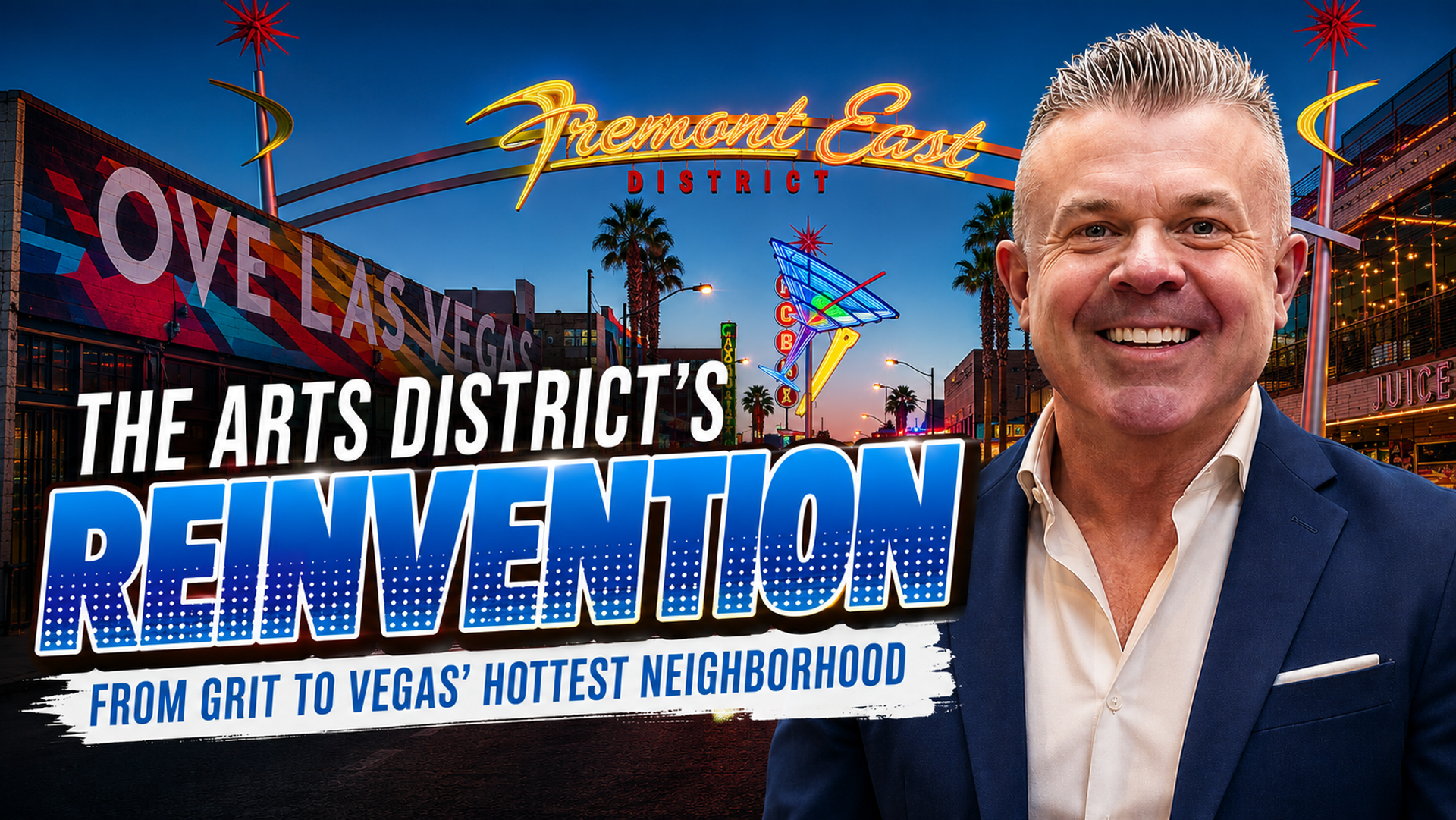
The Arts District's Reinvention: How Downtown's Grittiest Corner Became Las Vegas's Coolest Neighborhood
On the first Friday of October 2012, roughly 800 people showed up to walk the blocks between Charleston Boulevard and Colorado Avenue in downtown Las Vegas. They were there for art — paintings propped in parking lots, live music bleeding out of converted loading docks, cold beer poured through a chain-link fence. The city's arts community had been quietly colonizing these industrial blocks for years, but that night felt like a public announcement: this corner of Downtown Las Vegas was changing, and it wasn't going back.
That gathering was one of the early First Friday events, now a monthly fixture that draws thousands to what the city officially calls the 18b Las Vegas Arts District — 18 blocks of creative-use zoning carved out in 2002 that sat mostly dormant until artists, chefs, and small-business owners started taking the cheap rents seriously. What's happened since is one of the more dramatic neighborhood transformations in the valley's recent history, and The Arts District's Reinvention: How Downtown's Grittiest Corner Became Las Vegas's Coolest Neighborhood is a story with real consequences for anyone watching Las Vegas real estate today.
From Warehouses to the Valley's Most Interesting Block
The bones of the Arts District were never glamorous. The neighborhood grew up in the mid-20th century as a light-industrial and wholesale corridor — furniture warehouses, tile distributors, auto-body shops. When the Strip ate Las Vegas's economic oxygen through the 1990s and 2000s, these blocks went quiet. Rents dropped to levels that made no sense anywhere else in the valley.
That's exactly what attracted the first wave: Emergency Arts, a collective that opened inside a former medical building on Fremont, became an early anchor. Holsum Lofts converted a 1954 bread factory into live-work units — one of the first residential adaptive-reuse projects downtown. The Las Vegas Natural History Museum sits at the northern edge of the corridor, one of several civic institutions that gave the district credibility it couldn't have manufactured on its own.
Then came the breweries. CraftHaus Fermenter in nearby Henderson helped prove the market; PublicUs brought specialty coffee culture to Charleston Boulevard; later, vendors like the Downtown Container Park — an open-air retail center built from repurposed shipping containers just north of the Arts District boundary — demonstrated that people would show up, spend money, and come back.
By 2019, commercial rents on the district's core blocks had roughly doubled from their 2010 lows, according to local commercial brokers tracking the corridor. That compression started pushing some of the original tenants out — a familiar tension in any neighborhood that reinvents itself.
The Gateway District and the Next Pressure Wave
The momentum didn't stop at Charleston. The area just south — sometimes called the Gateway District, roughly bounded by Charleston to the north and Sahara to the south along Main and Commerce — became the next frontier. Vacant lots that sat for years are now permitted for mixed-use projects. A cluster of small hospitality businesses opened along Main Street between 2020 and 2023 that would have seemed implausible in that location a decade earlier.
City of Las Vegas planning data shows multiple infill residential projects approved or under construction within a half-mile of the Arts District core since 2021 — a mix of for-sale condos, market-rate rentals, and adaptive-reuse loft conversions. Pricing on the limited residential inventory in the immediate area has moved accordingly: livework lofts and condo units that traded in the low-to-mid $200s in 2018 were reaching $350,000–$450,000 by 2023 in comparable condition, reflecting both valley-wide appreciation and district-specific demand.
For investors, the short-term rental picture here is complicated. The City of Las Vegas has strict STR licensing requirements — primary residency rules apply in most residential zones, and the Arts District's mixed-use zoning creates a patchwork of what's permitted where. Anyone buying with a short-term rental strategy needs to verify the specific parcel's zoning before closing, not after.
Why It Matters Today
The Arts District's reinvention isn't finished — which is precisely why it matters right now. The neighborhood is in the middle of its story, not at the end. That means opportunity is still real, but so is the risk of overpaying for a block that's still more potential than polish.
What the district has demonstrably done is anchor a cultural identity for downtown Las Vegas that the corridor didn't have before. That identity attracts residents, employers, and eventually capital. The Brightline West rail station planned for the downtown corridor — connecting Las Vegas to the greater Southern California market — adds another variable that could meaningfully accelerate the timeline on surrounding property values if the project delivers on schedule.
For buyers who want urban walkability, genuine character, and proximity to a city center that's actually developing rather than stagnating, the 18b district and its surrounding blocks represent something genuinely rare in the valley. For homeowners already in the area, the trajectory is encouraging — though anyone thinking of selling should be watching comps carefully, because this market moves.
Kirby Scofield and the team have been tracking downtown closely for years. If you're curious about what's realistic in this corridor — what's actually selling, what's overpriced, and where the next inflection points might be — reach out. No pitch, just a straight answer.
Frequently Asked Questions
What is the 18b Las Vegas Arts District and where is it located?
The 18b Arts District is a designated creative-use zone in downtown Las Vegas, covering roughly 18 blocks centered on the intersection of Charleston Boulevard and Main Street, south of Fremont Street. The city established the arts zoning overlay in 2002 to encourage galleries, studios, and creative businesses; the neighborhood has grown significantly since the early 2010s with the addition of restaurants, breweries, and residential loft projects.
Are home prices in the Arts District actually rising compared to the rest of Las Vegas?
Yes, though on a smaller volume of transactions than suburban submarkets. Residential inventory near the Arts District core is limited, but comparable loft and condo sales showed meaningful appreciation between 2018 and 2023 — outpacing several established suburban corridors on a percentage basis. Buyers should note that values here are more sensitive to individual property condition and zoning specifics than in larger master-planned communities.
Can investors use Arts District properties as short-term rentals?
It depends heavily on the specific parcel and zoning classification. The City of Las Vegas requires STR licenses, and primary residency rules limit investor-owned short-term rentals in most residential zones. The Arts District's mixed-use zoning creates variability from block to block. Any investor considering an STR strategy in this area should pull the parcel's zoning records and confirm licensing eligibility with the City of Las Vegas before making an offer.