
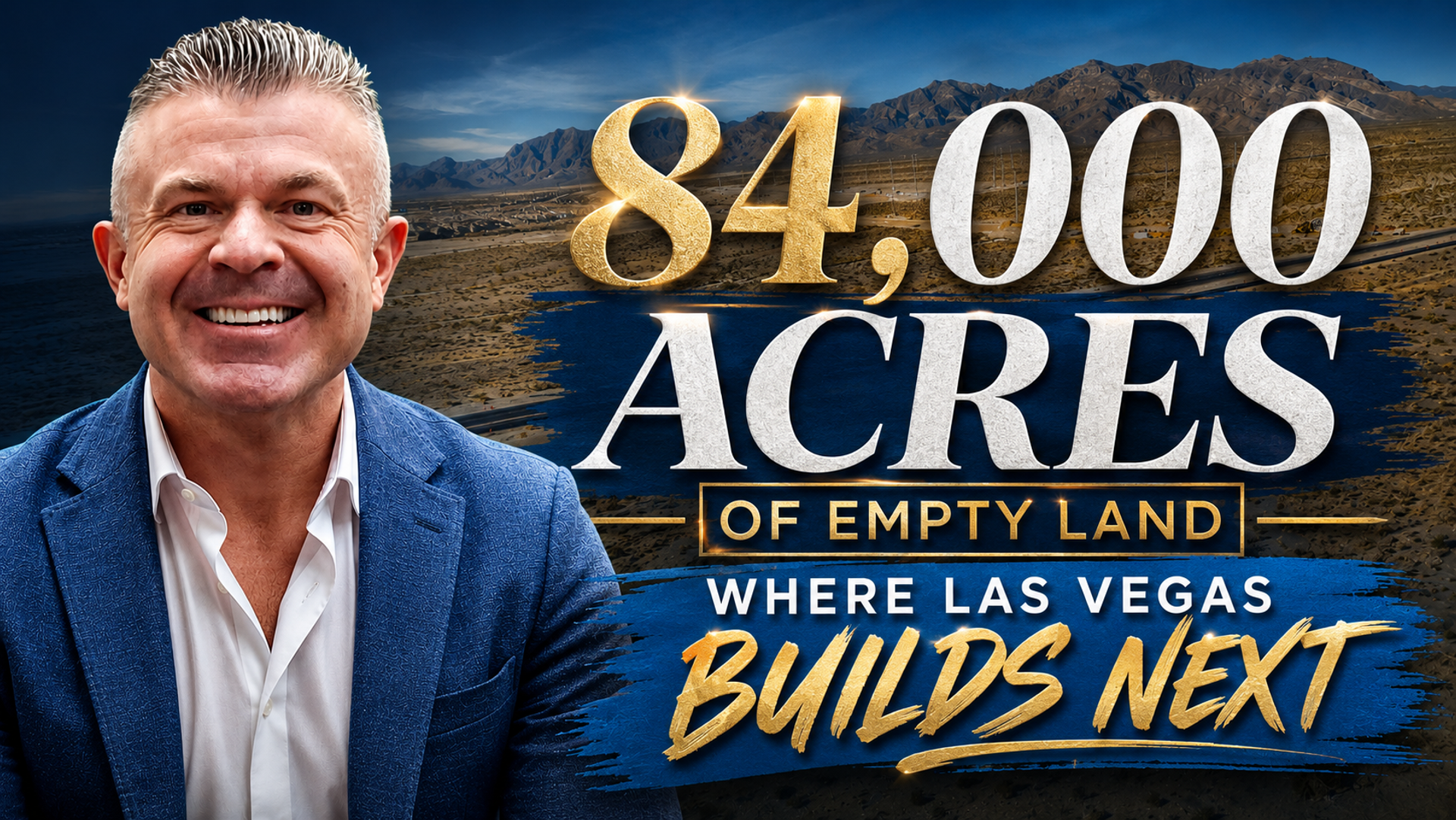
84,000 Acres of Empty Land in Clark County: Where Las Vegas Builds Next
Clark County still has roughly 84,000 acres of vacant developable land — but mountains, federal holdings, and military airspace are quietly shrinking that number faster than most residents realize.
A December 2024 study mapped that remaining inventory across the valley, and the findings matter beyond planning meetings. Land availability — or the lack of it — is one of the most underappreciated forces behind Las Vegas home prices. When buildable land tightens, new construction costs rise, resale inventory stays lean, and existing homeowners tend to hold more equity.
What the 84,000 Acres of Empty Land in Clark County Actually Tells Us
The headline number sounds large. In context, it isn't. Clark County covers roughly 8,000 square miles, but the Bureau of Land Management controls the majority of Nevada's land, and the federal checkerboard surrounding the Las Vegas Valley sets a hard ceiling on outward expansion. Layer on the Spring Mountains to the west, Lake Mead and the Mojave National Preserve to the east and south, and Nellis Air Force Base's restricted airspace to the northeast, and the valley's developable envelope is more constrained than the raw acreage suggests.
The 84,000 acres that remain are not evenly distributed. The largest contiguous pockets tend to sit in the outer northwest and southwest corridors — areas already in motion. Summerlin continues pushing toward its western edge against Red Rock Canyon. Henderson is building south and east toward the Black Mountains. North Las Vegas has acreage, but infrastructure gaps and distance from employment centers slow absorption there.
Where the Growth Is Actually Heading
Three corridors are worth watching:
• **Southwest Las Vegas / Rhodes Ranch to the 215 beltway:** Infill and new master-planned phases are filling gaps between established communities. Proximity to the Strip corridor keeps demand steady.
• **Henderson's southeast edge (Cadence, Inspirada, and beyond):** Henderson's master-planned communities have been the valley's most consistent growth story. As those phases near buildout, attention shifts further southeast where raw acreage still exists.
• **North Las Vegas:** Land is available and prices are lower, but buyers weigh the commute and infrastructure tradeoffs carefully. Longer-term upside if employment nodes shift north.
For Downtown Las Vegas, the calculus is different — infill, adaptive reuse, and vertical development replace horizontal expansion. Vacant parcels there are measured in acres, not thousands.
What This Means For You
• **Buyers:** New construction options will narrow over the next decade as buildable land is absorbed. Locking in a new-build now, especially on the valley's active southwestern and southeastern edges, means buying before scarcity fully prices in.
• **Investors:** Land-constrained markets historically support stronger long-term appreciation. Las Vegas is not Phoenix — the mountain and federal boundaries are real. That's a structural tailwind for well-located assets.
• **Current homeowners:** Tightening land supply supports existing home values over time. If you're curious what your home is worth in today's market, Find out what your home is worth →
• **Watch the BLM:** Congress periodically releases federal land for Southern Nevada development through the Southern Nevada Public Land Management Act. Those legislative decisions move markets here more than most people realize.
The valley isn't running out of land tomorrow. But the 84,000 acres of vacant land in Clark County is not an unlimited runway — it's a shrinking window, shaped by geography and federal policy more than by demand alone.
Frequently Asked Questions
How does vacant land availability affect Las Vegas home prices?
When developable land is plentiful, builders can keep new-home prices competitive, which also caps resale appreciation. As vacant land tightens — especially inside the valley's natural and federal boundaries — new construction costs rise, inventory stays lean, and existing homes tend to hold and grow value more reliably. It's one reason land-constrained metros like Las Vegas often outperform sprawling ones over a long cycle.
Which areas of Las Vegas have the most remaining land for development?
The largest concentrations of vacant developable land are in the outer northwest and southwest corridors near Summerlin's western edge, Henderson's southeast quadrant, and portions of North Las Vegas. Each area carries different infrastructure timelines and price points, so the opportunity looks different depending on whether you're buying to live in or hold as an investment.
What is the Southern Nevada Public Land Management Act and why does it matter?
The Southern Nevada Public Land Management Act (SNPLMA) authorizes the federal government to sell BLM-controlled land in Clark County and directs the proceeds toward conservation and public projects. Periodic SNPLMA land releases are a primary mechanism for expanding the valley's buildable footprint — which is why real estate watchers in Las Vegas follow federal land policy closely.